
Lipoderma and Renuva Together: The Biologic Combination Quietly Changing How We Approach Facial Aging
By Gica (Angelica), FNP, Owner, The Beauty Fix Med Spa · Scottsdale,…


By Gica (Angelica), FNP — Owner, The Beauty Fix Med Spa · Scottsdale, AZ
This is one of the questions I get most often from patients who are starting to do their research and it’s a great one. Because the honest answer isn’t “one is better than the other.” The honest answer is: they do fundamentally different things, and the best treatment plan often includes both.
Let me explain what I mean.
What Dermal Fillers Do
Dermal fillers — products like Juvederm, Restylane, and the RHA Collection, are hyaluronic acid-based gels that are injected to add immediate volume, shape, and support to specific areas of the face.
They are precise, predictable, and reversible. In the right hands, they’re extraordinary tools for:
Fillers work by physically occupying space. They’re placed strategically, and the results are immediate and visible.
They do not, however, change the biology of the tissue. They don’t rebuild fat compartments. They don’t improve tissue quality. And they require maintenance — typically every 12 to 24 months depending on the product and the area because the body slowly metabolizes them.
What Biologics Like Lipoderma and Renuva Do
Biologics approach facial aging from a completely different angle. Rather than adding a material to replace lost volume, they work with the body’s own biology to restore what has been lost.
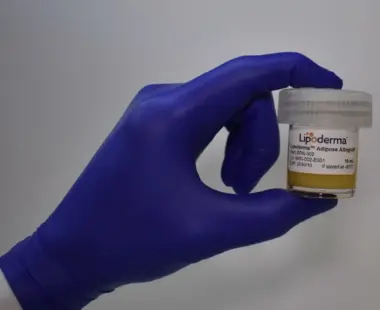
Lipoderma — composed of 90% adipose-derived cells and 10% extracellular matrix — replenishes the biological tissue itself. It restores the cellular environment, the structural scaffolding, and the regenerative signals that healthy, youthful tissue depends on.
Renuva works as an allograft adipose matrix — a scaffold that invites the body’s own fat cells to migrate, populate, and ultimately replace the treatment material with living, functioning tissue.
These treatments work progressively, over weeks and months, and they improve tissue quality in a way that fillers simply cannot. The results tend to look and feel remarkably natural — because the body is doing the work.
Why They’re Not Competing — They’re Complementary
Here’s where I want to be really clear, because I think there’s a misconception forming in the market as biologics gain attention: biologics are not a replacement for dermal fillers. They’re a different tool entirely.
A biologic can restore the fat compartments of the mid-face beautifully. But if a patient also has thin lips, a defined lip border, or structural support needs in the chin or jawline — those areas are still best addressed with a precise, targeted dermal filler.
Think of it this way:
The two work beautifully together. In many of my most comprehensive treatment plans, we layer biologic restoration with targeted filler work to achieve results that are both biologically sound and aesthetically refined.
When We Recommend Biologics Over Fillers
There are situations where biologics are clearly the better primary approach:
When We Still Recommend Fillers
Fillers remain the gold standard for:
Fillers are also still the right choice when the anatomy calls for precision — when we need to place product in a very specific plane, at a specific depth, to achieve a specific result.
The Conversation I Have with Every Patient
When someone comes to me interested in biologics, I never approach it as an either/or decision. I look at the face as a whole. I consider what’s changed, what the patient’s goals are, and what combination of tools will give us the most natural, lasting, and medically sound outcome.
Sometimes that’s a biologic protocol only. Sometimes it’s fillers only. Often, it’s a thoughtfully layered plan that uses both — each one doing what it does best.
That’s what individualized medicine looks like. And it’s the only way I know how to practice.
If you’re curious about how biologics, fillers, or a combination approach might apply to your specific anatomy and goals, I’d love to talk through it with you in a consultation. This is exactly the kind of conversation I look forward to most.
— Gica, FNP | The Beauty Fix Med Spa | Scottsdale, AZ
By Gica (Angelica), FNP, Owner, The Beauty Fix Med Spa · Scottsdale,…

At The Beauty Fix Medspa & Wellness, precision isn’t optional—it’s the standard….

Sign up with your email address to receive news, promotions, and updates.